1. What This Page Does
Given a percentage, convert it to CGPA. As simple as that. Enter the value above, select your board or university, and you're ready to go.
Most Indian schools award a percentage, but most universities, and CBSE specifically at Class 10, award a CGPA instead. That means the direction of conversion you need to do depends on where you're starting from or moving to. This page converts from percentage to CGPA; the opposite direction, from CGPA to percentage, is covered on another page on this site.
2. Why People Need This Conversion
A scholarship form asks for CGPA when your marksheet only shows a percentage — that's by far the most common reason anyone lands here. Some state government scholarship portals are set up this way, and one or two internal university eligibility checks have been written with a CGPA field in mind, even when the applicant is likely to have a percentage.
Curiosity is another driver. If a friend of yours is on a CGPA system and you're not, or vice versa, converting one to the other gives you an idea of where you stand relative to one another, instead of comparing two completely different numbers.
Government job applications sometimes ask for a percentage anyway even when the highest qualification has a CGPA — in which case you'd want the other direction of conversion, but it's worth mentioning here because people often don't know which one they need. Parents run into the same situation. A parent comparing the CGPA of a younger child (on CBSE) with the percentage of an older child, or trying to understand a report card with grade points, might well end up doing the same calculation you would for a scholarship, just for a different reason.
And then there's CBSE Class 10, which is significant enough to get its own full section below. CBSE awards Class 10 results as CGPA, and various follow-up steps including transfer certificates, some scholarship applications, and even informal comparisons between students' grades, require the percentage form.
Why This Calculator Is More Accurate
Most percentage-to-CGPA tools apply one flat formula to every student, regardless of university. This site uses the exact verified formula for your specific university — sourced from official circulars, not a generic estimate — so your result matches what's actually on your marksheet, not a rough guess.
3. The Formula
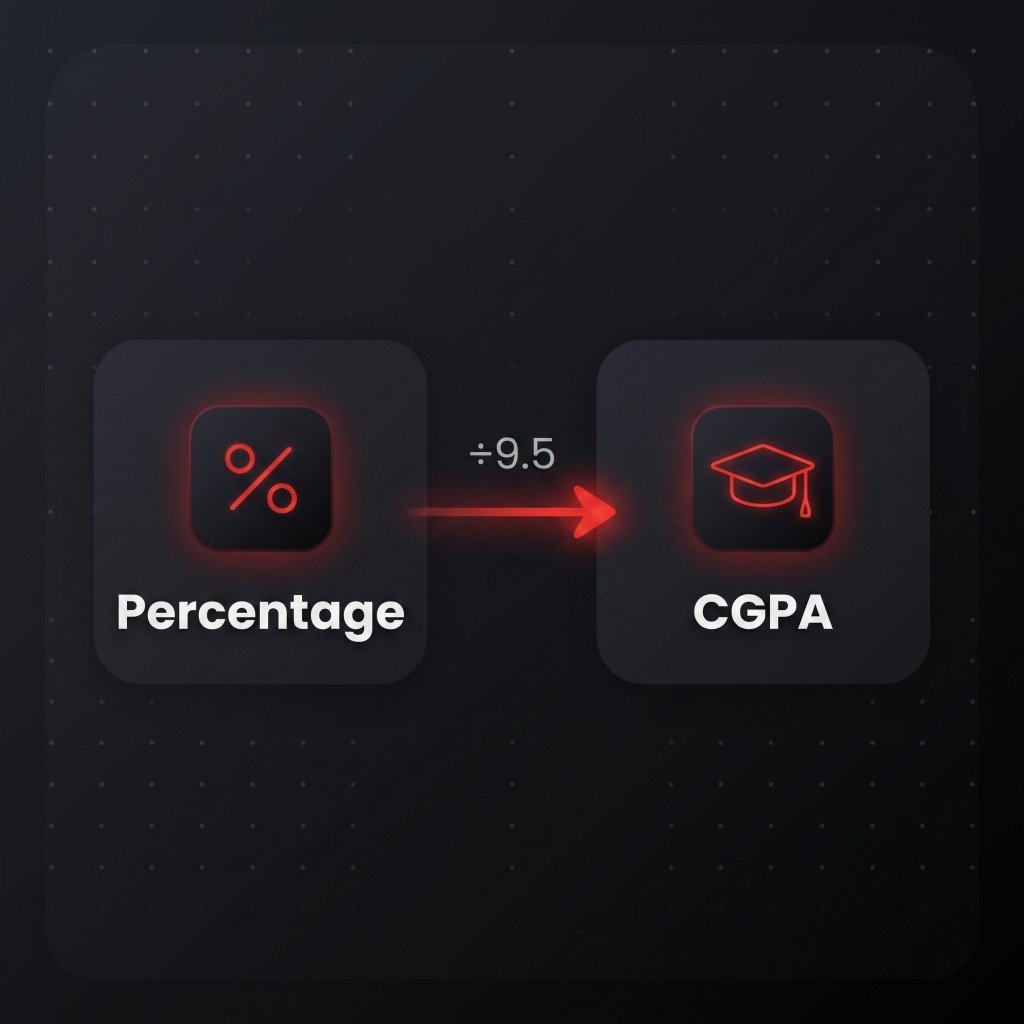
That's the general default, the one this calculator falls back to when your specific university doesn't have its own separate rule. Take 70%, divide by 9.5, you land on 7.37 — usually written as 7.4.
The multiplier used here has a real-world origin, rather than being picked out of thin air. The details of that origin are worth going into, so this section exists instead of just making a brief mention here.
4. Working From Raw Marks
Do you have raw marks, rather than a percentage already worked out? Convert the marks to a percentage before you begin. 550 out of 600 becomes (550 ÷ 600) × 100 = 91.67%. Run that through the formula above: 91.67 ÷ 9.5 = 9.65 CGPA.
Two steps, every time. Marks to percentage, percentage to CGPA. If you need to do this often enough that retyping the first step becomes tedious, the Marks Percentage Calculator on this site will handle it for you, automatically.
5. Percentage to CGPA Table (Out of 10)
Exact math (Percentage ÷ 9.5), not a rounded approximation:
| Percentage | CGPA |
|---|---|
| 95% | 10.00 |
| 90% | 9.47 |
| 85% | 8.95 |
| 80% | 8.42 |
| 76% | 8.00 |
| 75% | 7.89 |
| 70% | 7.37 |
| 66.5% | 7.00 |
| 65% | 6.84 |
| 60% | 6.32 |
| 57% | 6.00 |
| 55% | 5.79 |
| 50% | 5.26 |
| 47.5% | 5.00 |
| 45% | 4.74 |
| 40% | 4.21 |
| 38% | 4.00 |
| 35% | 3.68 |
6. Percentage to CGPA Table (Out of 4)
Some institutions use a 4-point grading scale, rather than 10. Formula: Percentage ÷ 25.
| Percentage | CGPA (4-Point) |
|---|---|
| 100% | 4.00 |
| 90% | 3.60 |
| 87.5% | 3.50 |
| 80% | 3.20 |
| 75% | 3.00 |
| 70% | 2.80 |
| 62.5% | 2.50 |
| 60% | 2.40 |
| 50% | 2.00 |
| 40% | 1.60 |
| 37.5% | 1.50 |
| 25% | 1.00 |
7. Where 9.5 Actually Comes From
CBSE introduced CGPA grading at Class 10 specifically to move away from exact marks, in favour of grade bands, and to reduce exam pressure. Students still need some way of estimating their percentage-equivalent, so CBSE used its own results data to pick a multiplier that would give a reasonable approximation of that percentage, based on where a particular student's CGPA placed them within the grade bands.
Students achieving the highest grade band (A1, 91–100 marks) averaged close to 95 across CBSE's own results data, and dividing that averaged value (95) by the top grade point (10) yields the multiplier this entire page is based on — 9.5. That's where it came from: real-world student results data, rather than just picking a number that looks good.
Two consequences follow from this. Class 10 is the only level this applies to — Class 12 results are already expressed as a percentage, and there's no CGPA awarded at that level at all; and the same multiplier applies, subject-by-subject, to your overall average, if you ever need an indicative percentage for one grade point rather than the whole record.
8. Boards Beyond CBSE — State Boards and ICSE
ICSE doesn't generally need this particular conversion, because results are generally reported as a percentage, the same way as CBSE reports Class 12 results. There's rarely any need for a CGPA conversion for ICSE students.
State boards vary. Several report percentage directly, the same way CBSE does for Class 12, so there's nothing to convert. A smaller number award CGPA and follow the same default multiplier rule as CBSE — dividing by 9.5 — because it's the most widely recognised standard in the country. A few publish a completely different formula, but this is uncommon at the school level, compared to how common it is among universities.
If you're unsure which category your board fits into, check your board's own examination department circular before assuming it fits CBSE's rule. Take the general default (÷9.5) to be a sensible approximation when nothing specific is published, rather than an exact match for every board.
This makes a difference at the school level rather more than it does elsewhere, because unlike universities, most state boards don't have the kind of easily-searchable circular archive that a university's examination office typically does. When in doubt, a call to your own school's administration office, dealing with your specific board's paperwork every day, usually resolves the issue faster than finding a published document online.
9. University-Specific Formulas
These are the reverse of the forward formulas already sourced and verified on this site's CGPA to Percentage page, cited by circular number when one exists.
- VTU (2015/2017/2018 scheme): (Percentage ÷ 10) + 0.75 • VTU Calculator →
- VTU (2021/2022 CBCS scheme): Percentage ÷ 10 • VTU CBCS Calculator →
- KTU Kerala (2019+ Scheme): Percentage ÷ 10 — Circular U.O.No. 1584/2023/KTU • Pre-2019: (Percentage ÷ 10) + 0.25 • KTU Kerala Calculator →
- Anna University: Percentage ÷ 10 • Anna Univ Calculator →
- Mumbai University: (Percentage − 11) ÷ 7.1 • Mumbai Univ Calculator →
- GTU: (Percentage ÷ 10) + 0.5 — Circular GTU/Academic/2013/4903 • GTU Calculator →
- SPPU: (Percentage ÷ 10) + 0.5 — Circular No. 332/2020 • SPPU Pune Calculator →
- MAKAUT/WBUT: (Percentage ÷ 10) + 0.75 — Letter COE/MAKAUT,WB/2021-22/0357 • MAKAUT Calculator →
- AKTU/UPTU: (Percentage ÷ 10) + 0.75 — Letter AKTU/RO/2019/1421 • AKTU Calculator →
- BPUT: (Percentage ÷ 10) + 0.5 • BPUT Calculator →
- Amity University: Percentage ÷ 9.5 • Amity Calculator →
- VIT (Vellore / Chennai / AP): Percentage ÷ 10 • VIT Calculator →
No published formula for your specific institution? The calculator falls back to the general formula and marks the result as an estimate rather than a verified one.
10. Same Percentage, Different Universities
Running a single number through several of these formulas side-by-side makes the difference immediately apparent that a list of formulas, on its own, doesn't convey.
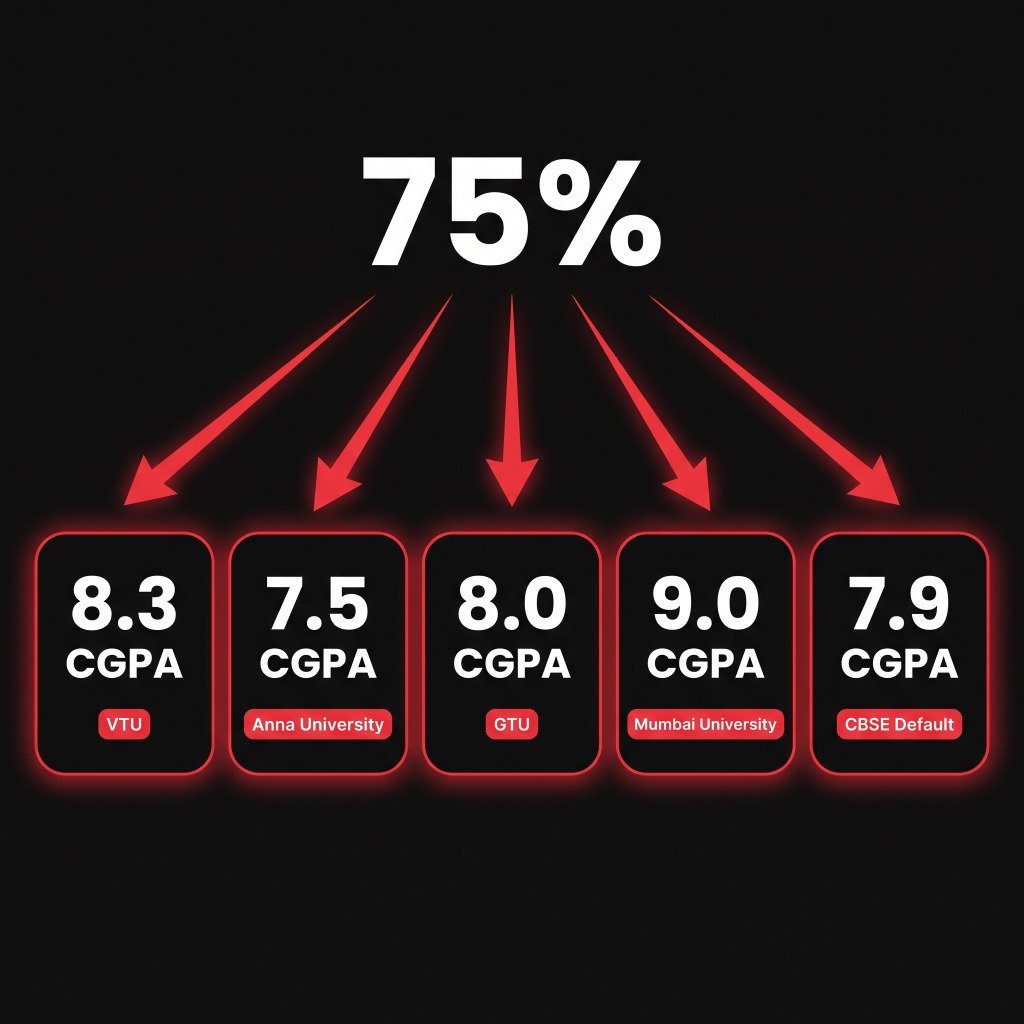
Take 75%. At Anna University: 75 ÷ 10 = 7.50 CGPA. Under VTU's older scheme: (75 ÷ 10) + 0.75 = 8.25 CGPA. At GTU: (75 ÷ 10) + 0.5 = 8.00 CGPA. At Mumbai University: (75 − 11) ÷ 7.1 = 9.01 CGPA. Under the general/CBSE default: 75 ÷ 9.5 = 7.89 CGPA.
Same starting percentage, and the answer varies widely depending on which formula is used — from 7.5 to just over 9.0. That's the entire reason why selecting the correct university in the calculator above matters more than getting the percentage right, if you're not certain which one applies to you — using the wrong formula produces a CGPA that won't match your actual institution's result, even if your percentage is correct.
11. Where People Go Wrong
Assuming that one simple divisor will work for every university, when it only applies to a couple of specific institutions (Anna University and VTU's newer scheme), as the previous section demonstrates.
Running a CBSE Class 12 result through the conversion formula, when Class 12 is already a percentage and there's nothing to convert.
Assuming ICSE or a state board uses CBSE's rule without checking, when the previous section shows that they often don't.
Forgetting that one university's formula specifies a subtraction step before dividing (Mumbai University's), and missing that entirely — dividing the percentage straight by 7.1 without subtracting 11 first — which leads to an extremely wrong result rather than a slightly off one.
Rounding the result during an intermediate calculation step, instead of at the very end. Rounding errors in intermediate steps accumulate to have a much larger effect, especially with multi-step formulas.
12. A Practical Walkthrough
It helps to see the whole process from start to finish, rather than just the formula on its own. Say a student has a Class 10 CBSE marksheet showing 462 out of 500 across their subjects, and a scholarship portal is asking for CGPA, not the percentage their marksheet actually shows.
First step, work out the percentage: (462 ÷ 500) × 100 = 92.4%. Second step, apply the CBSE formula from Section 3: 92.4 ÷ 9.5 = 9.73 CGPA. That's the number that goes on the form.
Now compare that to a different student with the same 92.4% but enrolled at a university using the Anna University formula instead of the CBSE one: 92.4 ÷ 10 = 9.24 CGPA — a different result, from the identical percentage, purely because a different formula applied. This is exactly the way the previous section warns against, and it's also exactly why the calculator above asks which institution you're converting for, before giving you a number, rather than just applying one formula to everybody.
A small gap in the calculation, when you get down to it, can be the difference between qualifying and not qualifying for a form with a strict cutoff — say, a scholarship portal where anything above 9.5 CGPA qualifies for a higher award tier, which would mean the 9.73 result qualifies and the 9.24 result doesn't. That's the practical reason why accuracy on the formula matters more than it might appear, from the maths side of things.
13. How Solid Is This
The core multiplier traces back to published reasoning from CBSE, rather than being an assumption borrowed from other calculator sites. The university-specific formulas are reverse calculations of existing forward formulas, also sourced from official circulars, with reference numbers cited where one exists.
None of that replaces your actual transcript. Board and university policies change over time, and individual institutions sometimes apply exceptions that don't get documented anywhere. Use this as a fast, well-sourced estimation tool only, and double-check against your official marksheet before submitting a converted number anywhere, formally or not, whether it's a job application, an admission form, or just an eligibility check.
14. Who This Is Actually For
Students converting a percentage to CGPA for a scholarship form, an eligibility check, or just comparing with a friend on a different system. CBSE Class 10 students specifically working out what their CGPA looks like as a percentage. Parents and teachers trying to understand how a percentage-based score compares with a CGPA-graded one. No login, no account — everything runs in your browser and stays there.
15. Summary
Which formula applies depends entirely on your board or university, rather than the percentage itself. There's a general default (÷9.5) that covers CBSE and unlisted institutions, university formulas vary from there, and CBSE's own version only covers Class 10, with an actual origin rather than just a guess. Pick the right institution in the calculator above for an instant, accurate number, or work the math out by hand using the examples throughout this page.