What Is CGPA, and How Does This Converter Work?
CGPA stands for Cumulative Grade Point Average, and this CGPA to percentage calculator helps you convert it accurately. It is used in India to denote a student's performance in his or her academics. Every semester, grades are assigned to a student's papers (usually on a 10-point scale) and are converted to grade points according to the credit system followed by the respective university. The CGPA is calculated using the weighted average of all the grades obtained in every subject according to the credits assigned for the course.
Many major Indian universities use the CGPA system of letter grading, including UGC, CBSE, VTU, Anna University, Mumbai University, GTU, SPPU, MAKAUT, AKTU, and more. These institutions have switched to using this grading system due to its ability to easily differentiate a student's overall performance in his or her coursework, despite different credit loads of various papers.
However, CGPA is a relative number, meaningful only within the context of a particular university. Almost every other organization, including government departments, employers, and universities accepting higher studies, requires a percentage rather than a CGPA. It is important to note that the CGPA of 8.2 in one university does not have the same value in another because there are different ways of converting CGPA to a percentage. This CGPA to percentage calculator works out the exact number for your CGPA, based on your university of record, so it can be used accurately as applicable to your marksheet.
Why Your Percentage Matters
If you are wondering why this conversion might be important to you, here are several reasons.
Many government jobs, including posts under SSC, require percentage marks as a qualifying criterion. If job eligibility criteria is 60%, you need to know your percentage before you apply, or you may waste your time if you are just below the cutoff. The same goes for higher studies, particularly when you are required to apply to a foreign university. These institutes usually ask for either a percentage or, in some cases, a GPA (explained further below), and you need to know ahead of time what you are likely to get on your application. A percentage is more commonly accepted than a CGPA when documents are being verified if your percentage doesn't match your CGPA.
Some on-campus placements have minimum CGPA criteria, but the placement representative may ask you to provide your percentage directly, or may ask you to provide your 10th and 12th marks as supplemental information if your CGPA is close to their cutoff. Having a ready percentage makes it much easier to provide this information quickly, rather than having to go through the CGPA to percentage calculation every single time.
How CGPA Is Actually Calculated
Before you can convert CGPA to a percentage, it's good to understand how CGPA is calculated in the first place. This is explained using the Subject-Wise Grade Calculator and SGPA Calculator linked on this page.
Every subject carries a different number of credits, depending on how long the course is and how important it is to your program. Generally, theoretical courses carry more credits (e.g. 4 credits) than lab courses (e.g. 1 or 2 credits). You get a grade point in your course based on your performance, and this gets multiplied by the number of credits for the course. Add all the weighted grade points and divide by the sum of the credits you have taken, and you will have your CGPA.
For example, suppose you earned grade points of 8, 9, 7, 10 and 9 in 5 courses, with each course worth 1 credit. Your total weighted grade points would be 8 + 9 + 7 + 10 + 9 = 43, and dividing that by 5 gives you a CGPA of 8.6. In practice, your grades would not be spread out equally as shown in this example, because different courses carry different credit hours.
For example, in an engineering program, one of your 4-credit core subjects may carry more weight than your 1-credit lab course. This means that a higher grade in the 4-credit course will raise your CGPA more than a higher grade in the 1-credit course would. Therefore, to calculate your CGPA correctly, you need to enter the credit hours for each course in the appropriate calculator mentioned above and let it do the math for you, rather than assuming that all your courses have equal credits.
Grade Points Explained
Most universities that follow the 10-point scale have a grading system similar to the following chart, which provides approximate letter grades and grade points for percentage marks, although cut-offs vary by institution (see below):
| Grade | Grade Point | Marks Range |
|---|---|---|
| O (Outstanding) | 10 | 90 and above |
| A+ (Excellent) | 9 | 80–89 |
| A (Very Good) | 8 | 70–79 |
| B+ (Good) | 7 | 60–69 |
| B (Above Average) | 6 | 50–59 |
| C (Average) | 5 | 45–49 |
| P (Pass) | 4 | 40–44 |
| F (Fail) | 0 | Below 40 |
How to Convert CGPA into Percentage
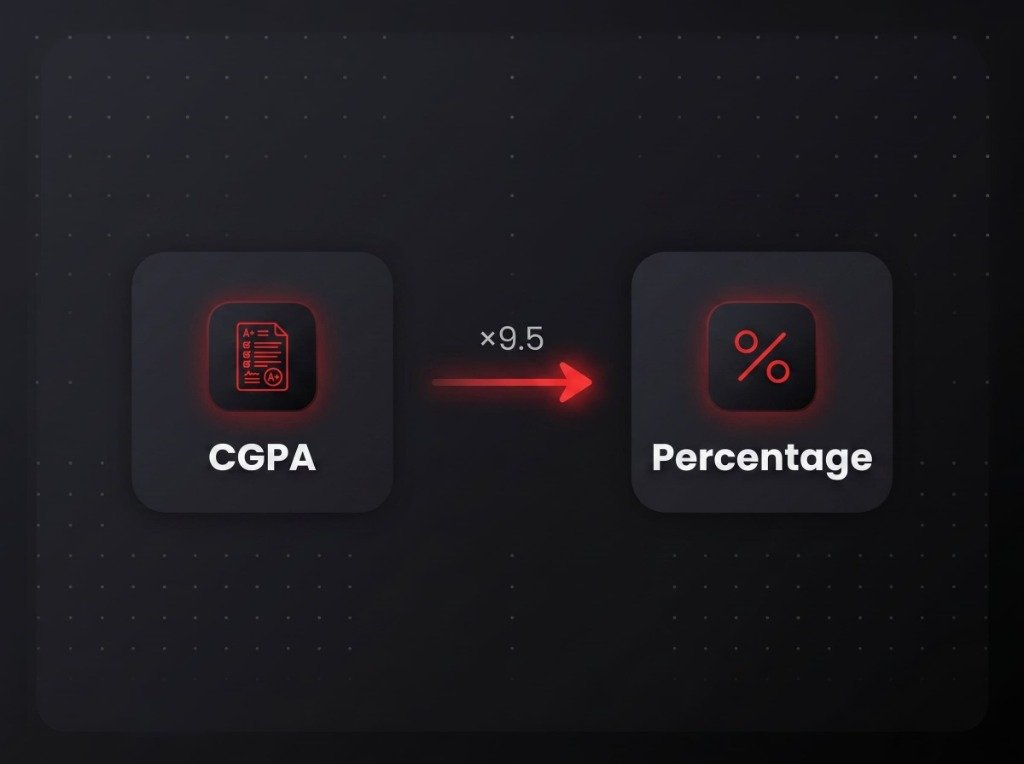
After calculating your CGPA, converting it to a percentage is a matter of multiplying it by a certain number, depending on your university. For UGC and CBSE, this multiplier is 9.5.
For example, if your CGPA is 8.4, you would multiply it by 9.5 to get 79.80%. This is the percentage that would be mentioned on your mark sheet, if you convert your CGPA using UGC or CBSE's method
However, there is a catch. Some universities do not simply multiply the CGPA by a single number to get a percentage, whereas others do. Always verify what method your university uses before attempting any calculation, particularly if you are going to use the result for a formal application.
Indian University-Wise CGPA to Percentage Formulas
Every Indian university has its own published method for calculating percentages based on CGPA, and these methods are not the same. Below is a list of the methods we have been able to verify for now, with a reference included if one was provided.
- CGPA × 9.5: This formula is used by UGC and CBSE, which are government bodies, so other universities usually follow their standards • UGC / CBSE Percentage Converter →
- VTU (2015/2017/2018): (CGPA − 0.75) X 10 • VTU CGPA to Percentage Calculator →
- VTU (2021/2022, CBCS): CGPA X 10 • VTU 2021/2022 CBCS Calculator →
- KTU Kerala (APJ Abdul Kalam Tech Univ): CGPA X 10 (Circular U.O.No. 1584/2023/KTU) • Pre-2019 Scheme: (10 X CGPA) − 2.5 • KTU Kerala CGPA Calculator →
- Anna University: CGPA X 10 • Anna University CGPA Calculator →
- Mumbai University (CBCS from 2016): (CGPA X 7.1) + 11 • Mumbai University CGPA Calculator →
- GTU: (CGPA − 0.5) X 10 (Circular GTU/Academic/2013/4903) • GTU CGPA to Percentage Calculator →
- SPPU: (CGPA − 0.75) X 10 (Circular No. 332/2020) • SPPU Pune CGPA Calculator →
- MAKAUT/WBUT (West Bengal): (CGPA − 0.75) X 10 (Letter COE/MAKAUT,WB/2021-22/0357) • MAKAUT WB CGPA Calculator →
- AKTU/UPTU (Uttar Pradesh): (CGPA − 0.75) X 10 (Letter AKTU/RO/2019/1421) • AKTU CGPA to Percentage Calculator →
- BPUT (Odisha): (CGPA − 0.5) X 10 • BPUT Odisha CGPA Calculator →
- Amity University: CGPA × 9.5 • Amity University CGPA Calculator →
- VIT (Vellore / Chennai / AP): CGPA × 10 (Ref: VIT/Dean (Acd)/2008/Gen/16) • VIT CGPA Calculator →
If your university is not listed above, we default to the UGC method, and this is clearly stated. More universities are added to this list regularly, and a formula will only be added if we have found an official source for it.
Quick Reference Table (10-Point Scale)
Below is a percentage conversion table for common CGPA scores, using the formula above.
| CGPA | UGC/CBSE | VIT | VTU | Anna Univ | Mumbai Univ | GTU | SPPU |
|---|---|---|---|---|---|---|---|
| 10.0 | 95.00% | 100.00% | 92.50% | 100.00% | 82.00% | 95.00% | 92.50% |
| 9.5 | 90.25% | 95.00% | 87.50% | 95.00% | 78.45% | 90.00% | 87.50% |
| 9.0 | 85.50% | 90.00% | 82.50% | 90.00% | 74.90% | 85.00% | 82.50% |
| 8.5 | 80.75% | 85.00% | 77.50% | 85.00% | 71.35% | 80.00% | 77.50% |
| 8.0 | 76.00% | 80.00% | 72.50% | 80.00% | 67.80% | 75.00% | 72.50% |
| 7.5 | 71.25% | 75.00% | 67.50% | 75.00% | 64.25% | 70.00% | 67.50% |
| 7.0 | 66.50% | 70.00% | 62.50% | 70.00% | 60.70% | 65.00% | 62.50% |
| 6.5 | 61.75% | 65.00% | 57.50% | 65.00% | 57.15% | 60.00% | 57.50% |
| 6.0 | 57.00% | 60.00% | 52.50% | 60.00% | 53.60% | 55.00% | 52.50% |
CGPA to Percentage on a 5-Point Scale
Some institutions also use a 5-point grading scale. On this scale, percentage marks are obtained by multiplying the CGPA by 20.
| CGPA (5-Point) | Percentage |
|---|---|
| 5.0 | 100% |
| 4.5 | 90% |
| 4.0 | 80% |
| 3.5 | 70% |
| 3.0 | 60% |
| 2.5 | 50% |
| 2.0 | 40% |
CGPA to Percentage on a 4-Point Scale
On the 4-point scale, percentage marks are obtained by multiplying the CGPA by 25.
| CGPA (4-Point) | Percentage |
|---|---|
| 4.0 | 100% |
| 3.5 | 87.5% |
| 3.0 | 75% |
| 2.5 | 62.5% |
| 2.0 | 50% |
| 1.5 | 37.5% |
Manual Calculation vs. Using the Calculator
The percentage can also be calculated using a standard formula for your university, or you can use the calculator provided conveniently above. Either way, you will get the same result. The only benefit of using the percentage calculator is that it reduces the chance of human error in calculation and helps you avoid using a university-specific formula incorrectly. Here's a practical example of why the CGPA percentage conversion might be helpful. A GTU student with a CGPA of 7.6 would calculate his percentage as follows, using the GTU formula: (7.6 − 0.5) X 10 = 71.00%. But if you were using the default UGC and CBSE formula, you would be calculating 7.6 X 9.5 = 72.20%, which would give you an entirely different result. You wouldn't get the percentage that would appear on your marksheet if you used the wrong formula for CGPA to percentage calculation for your university.
Percentage to CGPA. Going the Other Way
Sometimes, you may need to calculate your CGPA from your percentage, instead of calculating your percentage from your CGPA. This is done in a similar manner for different universities, where you divide your percentage by the divisor specified by your university, to get your CGPA. For example, for UGC and CBSE, you would divide your percentage by 9.5 to calculate your CGPA, so 76% would be converted to 8.0 CGPA. Similar steps apply for other universities (with the exception of those that specify a more complicated formula), with the exception of Mumbai University, which has the formula: (Percentage − 11) / 7.1 = CGPA. A detailed guide, including formulas, can be found on our Percentage to CGPA Calculator page.
SGPA vs. CGPA. What's the Difference?
SGPA stands for Semester Grade Point Average. It is a similar concept to CGPA, except that instead of being your cumulative grade point average over your entire course, it is your grade point average per semester. Your SGPA for a given semester, multiplied by the total number of credits you have taken in that semester, gives you your CGPA. The CGPA, in turn, is usually calculated as the weighted average of all your semesters' SGPA, depending on the credit hours for each semester.
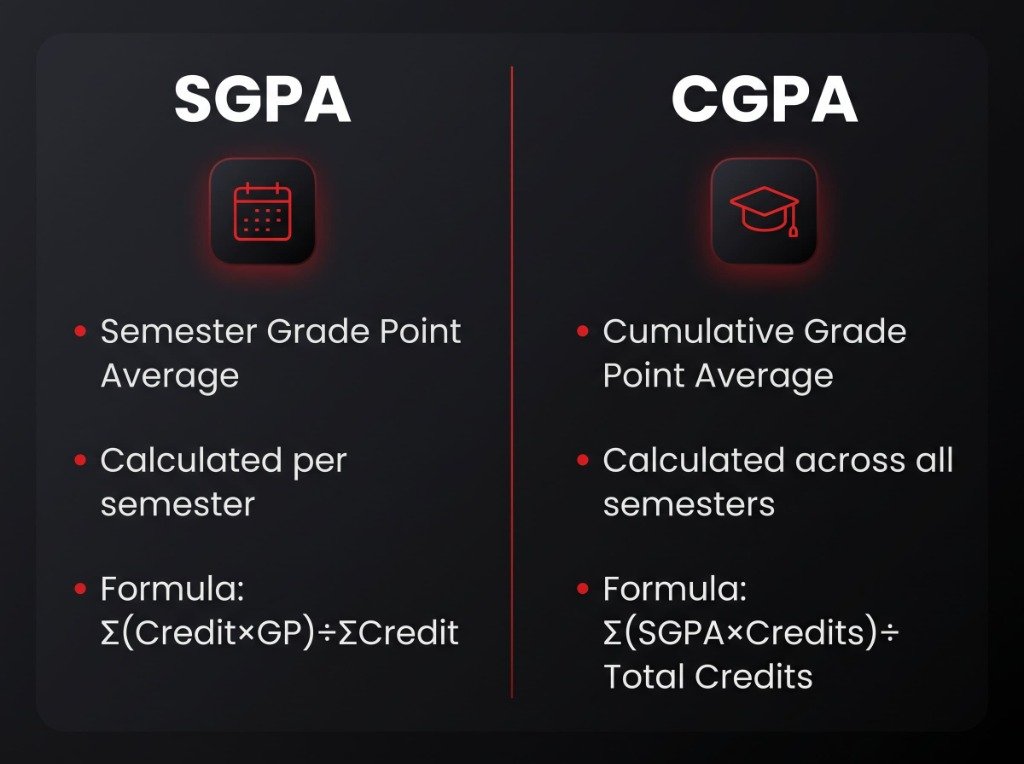
In other words, if one of your semesters had a particularly low SGPA, it would drag down your overall CGPA, compared to subsequent semesters with higher SGPA. In order to keep track of this, some students use the SGPA Calculator linked on this page, to calculate SGPA and CGPA semesters at a time, so they can see how their performance is affecting their grades.
CGPA vs. US 4.0 GPA
CGPA is often confused with the GPA used in the United States, or the 4.0 GPA, but the two scoring systems are actually quite different.
GPA is used to express a student's grade in a particular course in the US, as opposed to India's letter-grade-with-percentage system. A GPA of 3.7, for example, might mean that you got an A- in your course. On the other hand, a CGPA of 8.0 in India might mean you got an A in the course, or a percentage of 76%. Converting the 8.0 CGPA to a 4.0 GPA involves a simple formula, shown below:
The formula is used to convert Indian grades to the US system, and it can be applied to a CGPA in order to determine the approximately equivalent 4.0 GPA (in this case, the example converts to 3.36 GPA). It should be noted that some US universities may request you to get a formal credential evaluation from services like WES, as opposed to doing the calculation on your own. This conversion can be used if you don't need an official evaluation, but remember to check with the university to which you are submitting your application, if it requires a different process. Visit our US 4.0 GPA Calculator for detailed term planning.
Common Mistakes Students Make
There are some common errors that students tend to make when converting CGPA to percentage, or vice versa. Let's look at them:
- Assuming that you can apply a general ×9.5 or ×10 formula to your CGPA, regardless of your university: As shown above, while some universities do apply this formula, such as UGC, CBSE, and Anna University, others, like VTU, GTU, SPPU, MAKAUT, WBUT, AKTU, and Mumbai University, use different formulas. Applying the ×9.5 or ×10 formula to such universities' CGPA would give you incorrect percentages.
- Mixing up SGPA and CGPA: Some institutes ask specifically for SGPA or CGPA, so it is important to ensure you provide the one that has been asked for.
- Forgetting that your university's CGPA to percentage formula changes depending on the year or scheme of your course: This is particularly relevant for VTU, as the (CGPA − 0.75) X 10 formula (used for 2015, 2017, and 2018 admissions) stopped being used for 2021 and 2022 admissions, and was replaced by a different formula, of CGPA X 10.
How Accurate Is This
Every formula mentioned on this page comes from a verified university source. References are provided wherever possible so that you can do your own research. We made this tool because a lot of CGPA calculators online simply apply the ×9.5 or ×10 formula to all Indian universities, which may give you inaccurate results, if your university uses a different formula. However, it is always best to consult your university's registrar office, as there are some very specific exceptions for different colleges that we may not be able to account for on our end. If you are applying this percentage for something critical like government employment, a higher studies application, or an examination, double-check your calculations or the university's official document on the matter.
How We Verify Our Formulas
We only add a formula for a university to this page if we find a verified source for it, preferably a letter or circular from the university's main academic office. If there is a reference number for the source, we include it as well, so that you can research and verify it yourself. If a source cannot be found for a particular university, we avoid adding it unless we have reason to believe that a formula is general for the region, and we always note it as an estimate rather than a definitive source. We update this page regularly and add new universities as we find verified sources for them.
Raising Your CGPA
Some tips for raising your CGPA are outlined below, based on the principles underlying CGPA calculations:
- Study more for courses with higher credit hours: These courses contribute more towards your CGPA, than for lower-credit courses, so it makes sense to focus more of your effort on them.
- Pay attention to your internal assessment marks: These marks are usually much easier to boost, since you can earn them through regular attendance, assignments, and participation, compared to your end-semester exam marks.
- Check your CGPA frequently: Use the SGPA to CGPA Calculator linked on this page after every semester, rather than waiting until you finish your course, so that you can keep track of your progress. You can also calculate the SGPA you need to get in your upcoming semesters to achieve a certain CGPA, using the formula below:
Beyond that, the basic principles for boosting your CGPA are similar to principles that apply to boosting your grades in general: identify weak areas and focus on them, and revise strategically, a little bit every day, rather than waiting until just before your exams. None of these are particularly exciting, but they actually do work.
Who's This For?
This utility is intended for a wide range of people, including students, parents, and teachers. All you have to do is input your CGPA, and the percentage is calculated for you, without needing to log in or sign up. Your calculation history is stored in your browser, and no data is shared elsewhere.
Summary
Converting your CGPA to a percentage is a simple process, which mainly involves using the correct formula for your university. Fortunately, you can do it with ease using the calculator provided above or the formulas listed below. If you are going to be using this calculation for any official purpose, double-check with your university's documents before using it, as every university sets its own standard for the conversion.