
7 Min Read
By CGPAConverter
Last verified: October 2026
Imagine a student typing their university’s name into Google with “CGPA to percentage.” The result, time and again, is identical: multiply by 9.5. They do, and move on. Weeks later, filling up a competitive admission or job application, they discover the number on their marksheet or the circular pinned to their examination branch’s notice board does not match at all.
No, CGPA × 9.5 is not a universal formula. It originated in a single CBSE circular issued for Class 10 school board results, which a select few universities chose to adopt, while dozens of major institutions disregarded it completely. Delhi University officially uses it. So does NIT Delhi. But Anna University does not. Neither does VTU’s current scheme. Multiple technical universities apply a flat multiplication by 10, or subtract a fixed offset beforehand. Which rule applies to you has nothing to do with how many search results quote it, but exclusively with what your own institution has officially notified.
Where Nine Point Five Actually Comes From
The 9.5 multiplying factor is an empirical statistical estimate established by CBSE in 2010 for Class 10 grading, not an overarching higher-education mandate. It was derived by analyzing five years of board marks to reflect that candidates awarded the top A1 grade (Grade Point 10) clustered at a mean score of 95% marks (95 ÷ 10 = 9.5).
Rather than an urban academic legend, the factor has a concrete administrative origin: CBSE Circular Number 24 issued on 28th May, 2010 for Class XI admissions, which specified:
Formulated strictly as an indicative school-level measure; never printed directly on official grade sheets.
A few crucial details in that circular are far more revealing than the magic number itself:
- Limited Academic Scope: CBSE’s CGPA-based grading applied exclusively to secondary school students (Classes 9 and 10) from the 2009–2010 session until mandatory Class 10 board exams resumed in 2017–2018.
- Cluster Average Origin: The 9.5 figure did not stem from individual subject calculations; it emerged from averaging sample marks of top-performing cohorts over five years, approximating 95 marks for a 10 Grade Point.
- Strictly “Indicative”: CBSE explicitly labelled the figure “indicative” and deliberately never printed it on marksheets.
That last detail is the critical nuance almost every generic web page overlooks: 9.5 began as a school-level estimation for a single secondary board exam, and never carried any statutory mandate for college degrees or higher education. Any university that applies 9.5 today did so by independent administrative decision, not because of any binding directive from the University Grants Commission (UGC).
Which Universities Genuinely Use It
Prominent central institutions including Delhi University (DU) and National Institute of Technology (NIT) Delhi have formally notified the 9.5 multiplying factor for their degree programs. However, both institutions adopted this multiplier independently through internal academic resolutions rather than a nationwide standard.
Delhi University serves as the clearest documented example. Its Admission Branch issued an official notice in November 2021 for postgraduate admissions, defining the exact regulatory formula:
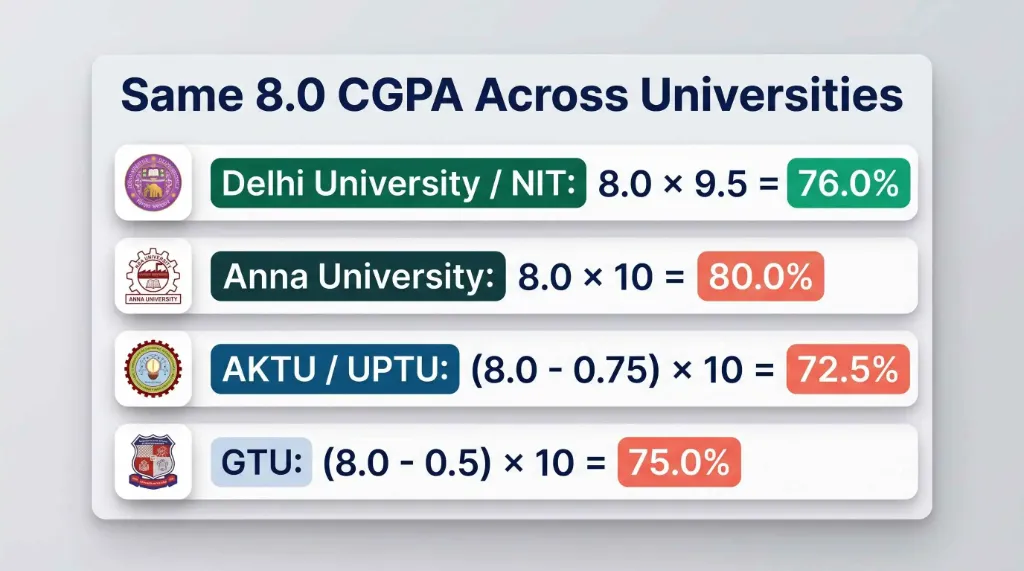
Similarly, NIT Delhi issued an official notification in 2013 confirming the identical equation, even publishing a worked benchmark: a CGPA of 7.50 converts to exactly 71.25% (7.5 × 9.5 = 71.25%).
Both universities selected this number independently. Their choice is not the product of a secret pan-Indian consensus across higher education, but two separate administrative bodies adopting CBSE’s historical indicative multiplier.
Universities That Use Something Else Entirely
India’s largest state technical universities — including Anna University, VTU, AKTU, GTU, and SPPU — reject the 9.5 factor in favor of flat multipliers, subtraction offsets, or tiered conversion slabs.
| University / Institution | Approved Statutory Formula | Regulatory Note |
|---|---|---|
| Anna University (Tamil Nadu) | CGPA × 10 | Flat multiplication; no subtraction offset (see correction below). |
| VTU (2021/2022+ CBCS Scheme) | CGPA × 10 | Straight multiplication enforced for all current engineering batches. |
| VTU (2015–2018 Legacy Scheme) | (CGPA − 0.75) × 10 | Deduction applied prior to multiplication for older batches. |
| AKTU / UPTU (Uttar Pradesh) | (CGPA − 0.75) × 10 | Mathematically identical to (CGPA × 10) − 7.5. |
| GTU (Gujarat Tech University) | (CGPA − 0.5) × 10 | Smaller initial deduction of 0.5 before multiplying by 10. |
| SPPU (Pune University) | Tiered Slab Table | Piecewise conversion ranges; not a continuous multiplier function. |
Correcting a Mistake That Keeps Getting Copied
The widespread online claim that Anna University mandates subtracting 0.75 or 7.5 from your score is completely false. This persistent error arose when unverified blogs copied AKTU’s Uttar Pradesh conversion equation and mistakenly attributed it to Anna University in Tamil Nadu.
The Anna University Equivalence Reality
An authentic conversion certificate issued by an Anna University affiliated engineering college states explicitly in writing:
Anna University’s Controller of Examinations certifies a flat multiplication by 10 and zero deductions. If you encounter the “subtract 7.5” rule paired with Anna University, it is inaccurate regardless of how many search results copy it. Use our verified Anna University CGPA Calculator for certified scores.
Not Every University Even Uses a Multiplier
Certain statutory universities, most notably Savitribai Phule Pune University (SPPU), do not employ a mathematical multiplier equation at all; they enforce discontinuous tiered slab tables.
Under a slab system, specific CGPA ranges map directly to fixed percentage bands rather than evaluating through a continuous algebraic formula. If your institution implements a tiered matrix, applying 9.5 or 10 will never produce the certified percentage that appears on your degree dossier. You must evaluate against the approved slab notification via our dedicated SPPU CGPA Converter.
Worth noting, SPPU does also have a simpler (CGPA − 0.75) × 10 formula in circulation, and it isn’t wrong exactly — it’s used across most faculties as a quick estimate. The distinction matters: that formula is for a rough read on where you stand, while Circular 332-2020’s tiered bands are what the university actually applies when certifying an official percentage. Quote the slab table, not the estimate, on anything official.
What This Actually Means for You
The only conversion rule legally recognized on competitive applications (UPSC, GATE, CAT, SSC, PSU recruitments, or foreign university admissions) is the formula certified by your own issuing university. A generic multiplier is merely an informal estimate.
Always verify your conversion across these three authoritative checkpoints:
Inspect the back of your consolidated transcript or grade card. Most universities print their approved formula or equivalence note in the footer margin.
Check academic ordinances or circular notifications issued by your Controller of Examinations (as seen with DU, NIT Delhi, and VTU).
For corporate onboarding (TCS, Infosys, Wipro) or PSU verification, obtain a formal signed conversion certificate directly from your registrar.
Need your raw semester marks converted into a percentage directly without navigating grade points? Our Marks Percentage Calculator calculates your aggregate score instantly. To explore all 40+ state and central university formulas, browse our Indian Universities Conversion Hub.
Frequently Asked Questions (FAQ)
Is CGPA times 9.5 official for all universities?
No. It originated in a 2010 CBSE circular for Class 10 school board results. While select universities (like Delhi University) chose to implement it, UGC has never mandated 9.5 as a nationwide higher-education standard, and prominent institutions like Anna University and VTU use completely different equations.
Does Delhi University really not use 10 as its multiplier?
Yes, DU does not use 10. The Delhi University Admission Branch specifically notified 9.5 in writing (most recently confirmed in official PG admission notifications), and affiliated colleges continue quoting Percentage = CGPA × 9.5 on official transcripts.
Why doesn’t Anna University subtract 7.5 or 0.75?
Because subtraction is not Anna University’s rule. That deduction belongs to AKTU / UPTU in Uttar Pradesh. Anna University officially specifies a flat multiplication by 10 (Percentage = CGPA × 10) without any offset, confirmed on conversion certificates issued by its affiliated colleges.
What if my own university is not mentioned here?
Do not guess or assume it uses 9.5. Always check the reverse side of your marksheet, consult your examination branch notice board, or request an official conversion certificate from your Controller of Examinations to be certain.
Official Regulatory Sources & Citations
This analysis complies with published regulatory circulars and examination notifications:
- CBSE Circular No. 24/2010: Official introduction of grading and the 9.5 indicative multiplying factor.
- University of Delhi Admission Branch Notice (18 Nov 2021): Mandatory 9.5 multiplication rule for PG admissions.
- NIT Delhi Conversion Circular (2013): Statutory formula declaration and worked calculation benchmark.