
8 Min Read
By CGPAConverter
Last verified: September 2026
One odd thing about academic scores is that a number can seem completely intuitive on your marksheet and defy all logic the moment another application form asks you to write it down in a different shape. Your transcript may say it’s an 8.2 CGPA, but the application in front of you demands an exact percentage — leaving you frantically searching for a formula that will make sense of mutually-exclusive calculations.
This confusion happens because GPA, CGPA, and percentage aren’t just the same score in different notations. Each metric is derived from a specific set of rules governing letter grade assignments, credit weighting, and institutional grading ordinances. Once you identify which specific rule your marksheet uses, the math is straightforward. If you need immediate calculations, explore our Master CGPA to Percentage Calculator, browse our Directory of 40+ University Formulas, combine semester scores with our SGPA to CGPA Calculator, or perform reverse evaluation via our Percentage to CGPA Calculator.
What Is GPA, and Why the 4.0 Scale Isn’t the Whole Story
Grade Point Average (GPA) is a score normalization method where letter grades earned in individual courses are translated into numerical points and averaged across a single academic term. While widely associated with the North American 4.0 scale, Indian and European universities predominantly deploy 10-point GPA variations under Choice Based Credit System (CBCS) frameworks.
The primary hurdle in understanding GPA is not the scale itself — it is the underlying grade-point mapping table that dictates how a raw score or letter grade converts into numerical grade points. Institutional policies differ significantly:
- Granular Letter Splits: Some universities distinguish between
A+(10 points) andA(9 points), orA-(8.5 points), rewarding marginal performance tiers. - Categorical Rounding: Other institutions group wide percentage bands (e.g., 80% to 100%) into a uniform grade point, eliminating distinctions between high and border-line scorers.
- Differential University Tables: Two students graduating with identical percentage marks across equivalent subjects from different colleges will frequently hold divergent GPAs due to varying grade boundaries.
Credit hours further skew direct comparisons. Suppose you secure an O Grade (10 Grade Points) in a 1-credit elective course, but receive a B Grade (6 Grade Points) in a 4-credit core engineering module. Because the core course carries four times the academic weight, its lower performance pulls your term GPA down far more heavily than the elective can elevate it.
What Is CGPA — and How SGPA Feeds Into It
Cumulative Grade Point Average (CGPA) represents the overall credit-weighted average of all grade points accumulated across every completed semester of a degree program. In Indian higher education, Semester Grade Point Average (SGPA) records single-term performance, and each successive SGPA rolls into the cumulative CGPA until graduation.
This is where manual self-calculation frequently goes astray. Consider this common scenario:
The Common Calculation Pitfall:
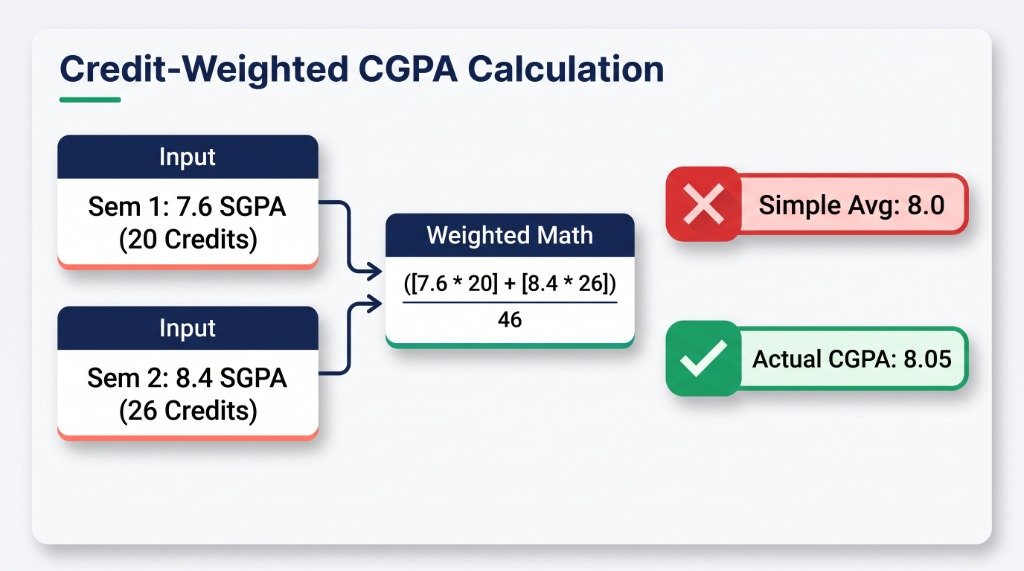
- Semester 1: 7.6 SGPA (earned across 20 credits)
- Semester 2: 8.4 SGPA (earned across 26 credits)
A student might intuitively compute a simple arithmetic mean: (7.6 + 8.4) ÷ 2 = 8.00. However, because Semester 2 carried 26 credits versus Semester 1’s 20 credits, Semester 2 holds substantially higher weight. The actual cumulative calculation is:
The official marksheet reports 8.05, not 8.00. Unweighted arithmetic averaging is the number-one reason self-calculated CGPAs disagree with official transcripts.
Does Every Subject Count Toward CGPA?
No, not every subject on your syllabus affects your CGPA. Non-credit audit courses, mandatory non-evaluative modules, and extracurricular credits are excluded from calculations, whereas failed subjects (backlogs) carry a punitive 0-point weight that drags cumulative scores down.
1. Backlogs, Arrears, and Failed Subjects
When a student fails a course, the institution assigns 0 Grade Points for that subject. However, the assigned credit hours of that course remain in the denominator of the CGPA equation. Because the credits count but contribute zero points, backlogs exert a severe mathematical drag on your cumulative average:
- The Drop: If a student maintains a 7.80 CGPA through Semester 3 and fails a 4-credit core subject in Semester 4, their cumulative standing can plunge to roughly 6.80.
- The Clearance Ceiling: When clearing the backlog during a supplementary examination, many universities cap the cleared grade or record a B-grade (e.g., 6 points). This lifts the cumulative standing only to approximately 7.00 — remaining far below the initial 7.80 baseline.
Regional Terminology Across Indian Universities
Depending on state jurisdiction and university acts, the exact same academic backlog is designated by different official terms:
2. Audit and Non-Credit Courses
Courses marked on your grade card as “Audit”, “Non-Credit”, “Mandatory Non-CGPA”, or “Satisfactory/Unsatisfactory” (such as Environmental Studies, Constitution of India, or Induction Programs) are excluded from the mathematical formula. While passing them is mandatory for degree conferral, they possess zero credit weight and do not alter your SGPA or CGPA.
CGPA, Percentage, and Percentile Aren’t the Same Thing
Percentage represents an absolute score ratio, CGPA is a weighted grade average, and Percentile is a comparative ranking metric. Confusing these three distinct measures on competitive examination applications (such as CAT, GATE, or UPSC) is a frequent source of candidate disqualification.
| Metric | Definition & Nature | Standard Scale | Primary Purpose |
|---|---|---|---|
| Percentage (%) | Absolute Ratio: Total marks earned divided by maximum possible marks multiplied by 100. | 0.00% to 100.00% | Direct performance evaluation; legacy eligibility cutoffs. |
| CGPA | Weighted Average: Cumulative sum of credit-weighted grade points divided by total credits. | 10-Point Scale (India) or 4.0 (US) | Standardized university grading reflecting continuous curriculum mastery. |
| Percentile | Relative Rank: Percentage of candidates in the test pool who scored equal to or below your score. | 0.00 to 100.00 Percentile | Competitive entrance exams (CAT, JEE Main, NEET) measuring peer standing. |
Key Illustration: Scoring in the 90th Percentile does not mean you answered 90% of exam questions correctly; it signifies you performed higher than 90% of all candidates who sat for the examination.
Why “CGPA to Percentage” Has No Single Formula
There is no single universal formula for converting CGPA to percentage in India because state and central universities operate under independent statutory charters. While the University Grants Commission (UGC) Choice Based Credit System guidelines standardize the computation of SGPA and CGPA, the conversion into percentage is explicitly delegated to individual university academic councils.
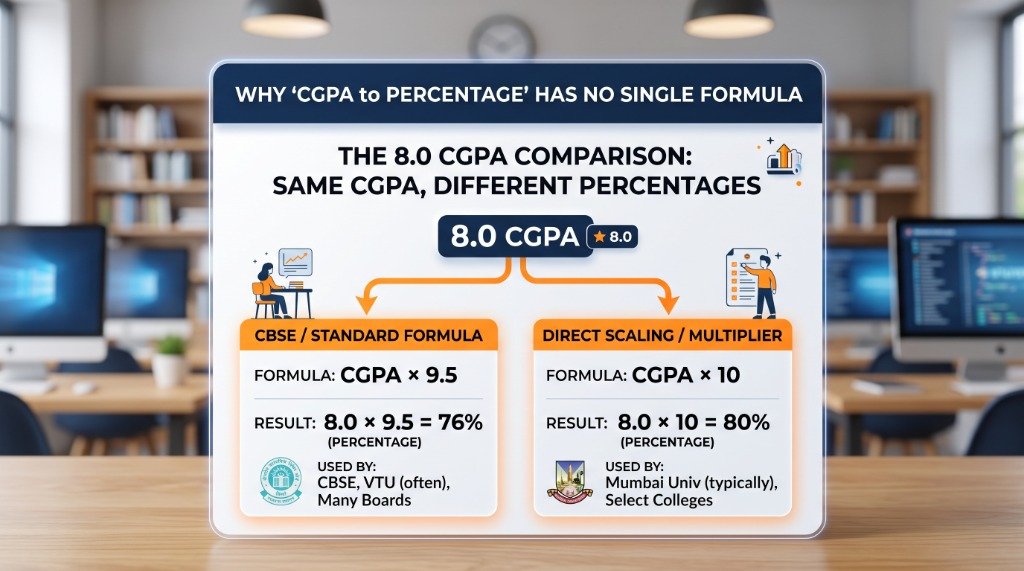
The Central Board of Secondary Education (CBSE) established the ubiquitous CGPA × 9.5 formula based on sample clustering of A1 grade holders averaging 95 marks. However, across India’s premier technical and state universities, statutory equations diverge substantially:
- Direct Multiplier (× 10): Enforced by VTU (2022+ Scheme), KTU Kerala, Anna University, and VIT. An 8.0 CGPA converts directly to 80.00%.
- CBSE / UGC Standard (× 9.5): Followed by Central Universities, Delhi University (prior guidelines), and Osmania University approximations. An 8.0 CGPA yields 76.00%.
- Fixed Offset (CGPA − 0.75) × 10: Used by SPPU Pune, MAKAUT West Bengal, AKTU Lucknow, and legacy VTU schemes. An 8.0 CGPA converts to 72.50%.
- Fixed Offset (CGPA − 0.5) × 10: Enforced by GTU Gujarat and BPUT Odisha. An 8.0 CGPA converts to 75.00%.
- Polynomial Scale (7.1 × CGPA + 11): Enforced by Mumbai University for its 10-point engineering scale. An 8.0 CGPA converts to 67.80%.
To view official notifications, circular PDFs, and precise calculation calculators for your specific campus, visit our verified Indian Universities Conversion Directory.
Should You Even Convert? (Application-Form Reality Check)
Before converting your CGPA to percentage, verify whether the receiving organization explicitly requests a conversion. If an admissions portal or job application offers dropdown options for “CGPA / GPA (10-Point Scale)”, you should submit your native CGPA exactly as stated on your transcript.
Unnecessary conversion can harm your application:
- International Credential Evaluation (WES, ECE): Organizations like World Education Services (WES) specifically demand unedited official transcripts in their original notation. Converting numbers yourself can cause discrepancies during document verification.
- Official Conversion Certificates: PSU recruitments (BHEL, IOCL, ONGC) and state public service commissions mandate that if you enter a percentage derived from CGPA, you must upload an official conversion certificate signed by your Controller of Examinations.
- Transcript Margins: Always inspect the reverse side or footer of your grade sheet. Most universities print their approved conversion formula or an explicit disclaimer stating: “No conversion formula to percentage is recognized.”
Why Two Online Calculators Can Disagree
When two online calculators yield conflicting percentages for the exact same CGPA, it does not mean either calculator contains an arithmetic bug; rather, each calculator is hard-coded to a different institutional formula.
Generic internet calculators apply the default CGPA × 9.5 formula unconditionally. If you attend a university that uses CGPA × 10 or (CGPA − 0.75) × 10, a generic calculator will return an erroneous figure. A web tool is merely an arithmetic assistant — the authoritative benchmark remains your university’s official academic ordinance.
A Realistic Example: When Your Own Math Doesn’t Match the Marksheet
Suppose you calculate your cumulative average as 7.90 CGPA, but your provisional certificate reads 7.85 CGPA. Before assuming a clerical typo or rounding error, audit these three critical factors:
Did you use actual course credits from your scheme regulations, or assumed every subject carries equal 3 or 4 credits?
Did you account for repeat attempts at their cleared grade points rather than averaging both initial failed zero points and cleared points?
Did you weight every semester by total credits completed, or simply sum your SGPAs and divide by the number of semesters?
Frequently Asked Questions (FAQ)
Is CGPA the same as GPA?
Not quite. GPA typically measures academic performance over a single semester or term (often called SGPA in India), whereas CGPA aggregates and credit-weights performance across all completed semesters of your degree program.
Does a backlog affect my CGPA permanently?
While clearing a backlog replaces the 0-grade-point penalty with your passing grade, your overall CGPA rarely returns to where it would have been had you passed on the first attempt, because cleared grades are often capped or lower than your overall average.
What is the difference between percentage and percentile?
Percentage is an absolute score representing the ratio of marks obtained out of total possible marks. Percentile is a relative rank indicating the percentage of competitors you outperformed (e.g., the 90th percentile means scoring better than 90% of exam test-takers).
Should I convert my CGPA before an international application?
No, unless explicitly mandated. International universities and evaluation agencies like WES prefer original transcripts with native grading notations to execute standardized internal credential evaluations.
Why do two CGPA-to-percentage calculators give different answers?
Because each calculator is built around a different formula (e.g., standard 9.5 vs university-specific direct 10 or offset subtraction). Both may be mathematically correct for their respective target institutions.
Do audit or non-credit courses count toward CGPA?
No. Only courses with assigned academic credit hours factor into SGPA and CGPA equations. Non-credit and audit courses carry zero credit weighting.
Official Regulatory Sources & Citations
This analysis complies with published regulatory circulars from national and state educational governing bodies:
- CBSE Circular No. 24/2010: Introduction of Continuous Comprehensive Evaluation & 9.5 conversion multiplier.
- UGC Choice Based Credit System (CBCS) Guidelines: Standardized computation of SGPA and CGPA.
- Delhi University Examination Notification: CGPA conversion benchmarks.
- Osmania University Engineering Regulations: Evaluation schemes and grading procedures.