
Here’s something that most online CGPA to Percentage guides won’t tell you right off the bat: there is no single universal formula for all Indian colleges. Ask five different students taking five different degrees from five different universities what their CGPA converts to, and you’re almost guaranteed to receive five completely different percentages — all correct according to their respective university circulars.
We engineered the CGPA2Percent Calculator Engine specifically because outdated forum posts and generic blogs assume every Indian university follows the exact same multiplier. In practice, universities have enacted distinct grading ordinances. This comprehensive guide walks you through the official default formula, explains the statistical rationale behind the 9.5 factor, maps every score on our 61-point reference chart, and details verified university-specific conversion rules. Need the inverse calculation? Our Percentage to CGPA Calculator handles that, while our SGPA to CGPA Calculator combines multiple semester records seamlessly.
What Is CGPA and How Does It Convert to Percentage?
Cumulative Grade Point Average (CGPA) is the credit-weighted average of your grade points across all completed semesters, typically evaluated on a 10-point scale. To convert CGPA to percentage, most Indian institutions use the standard CBSE/UGC formula (CGPA × 9.5), though prominent state universities like VTU, KTU, Anna University, and Mumbai University enforce unique regulatory equations.
Unlike raw marks percentages that treat all subjects identically, CGPA accounts for the academic weight (credits) of each subject. Converting your final score accurately is critical for government examinations (UPSC, SSC, GATE), higher education admissions, and campus recruitment eligibility checks (TCS, Infosys, Wipro).
How Is CGPA Calculated?
Before converting your CGPA to a percentage, it is essential to understand that CGPA is not a simple mathematical average of your percentage scores across semesters. Indian universities operating under the UGC Choice Based Credit System (CBCS) employ a two-tiered weighted evaluation:
- Grade Point Assignment: Marks scored in individual subjects (theory and practical) are converted to Letter Grades and corresponding numerical Grade Points on a 10-point scale (e.g., 90–100 marks = O Grade / 10 points; 80–89 marks = A+ Grade / 9 points).
- Semester Grade Point Average (SGPA): Each subject’s grade point is multiplied by its allotted credits. Core subjects (4 credits) contribute four times more weight than elective or laboratory modules (1 credit). The sum of credit points divided by total semester credits yields your SGPA.
- Cumulative Grade Point Average (CGPA): SGPAs from all semesters are averaged on a cumulative credit-weighted basis across your entire degree program.
Standard UGC / AICTE Credit-Weighted Grade Point Formulation
CGPA to Percentage Formula, and Why There Isn’t Just One
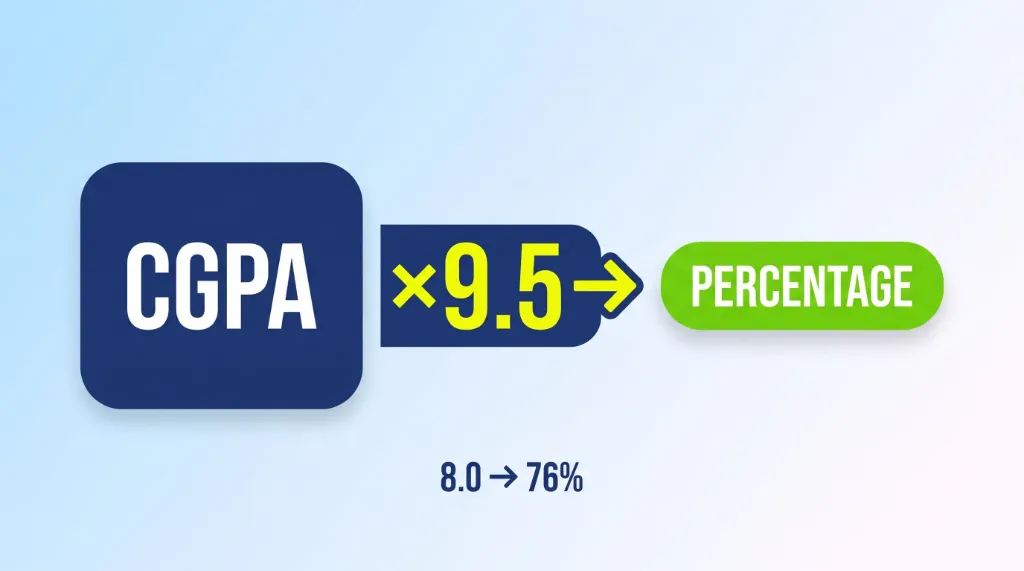
The calculation most students encounter first — and the official benchmark established by the Central Board of Secondary Education (CBSE) — multiplies the 10-point CGPA by 9.5:
What Is the CGPA Multiplying Factor?
The 9.5 multiplying factor is an empirically derived statistical constant introduced by CBSE to reflect realistic academic performance distributions. When analyzing historical board marks, CBSE discovered that candidates awarded the top A1 grade (Grade Point 10) did not universally achieve 100 marks; rather, their mean performance clustered at 95 marks across all 5 subjects.
Dividing this 95-mark cluster mean by the maximum 10 Grade Point produced exactly 9.5: 95 ÷ 10 = 9.5. AICTE adopted this rationale for engineering institutions, establishing 9.5 as India’s widespread default. However, because higher educational institutions maintain statutory autonomy under State Legislative Acts, dozens of universities have legislated alternative conversion formulas.
Free CGPA to Percentage Calculator
Rather than manually solving arithmetic equations or guessing which scheme applies to your passing year, use our interactive conversion engine below. It automatically maps your institution’s approved statutory formula:
If you study under an international or North American grading system, our dedicated US 4.0 GPA Calculator translates semester transcripts into 4.0 grade point scales. For students computing overall scores directly from subject marks, our Marks % Calculator eliminates grade points entirely.
Every CGPA Value, Converted (Quick Reference Table)
The table below provides pre-calculated percentage values for every 10-point CGPA score from 4.0 to 10.0 in increments of 0.1, calculated under the national CBSE / UGC 9.5 factor standard:
| CGPA (10-Point Scale) | Calculated Percentage (× 9.5) |
|---|---|
| 4.0 | 38.0% |
| 4.1 | 38.95% |
| 4.2 | 39.9% |
| 4.3 | 40.85% |
| 4.4 | 41.8% |
| 4.5 | 42.75% |
| 4.6 | 43.7% |
| 4.7 | 44.65% |
| 4.8 | 45.6% |
| 4.9 | 46.55% |
| 5.0 | 47.5% |
| 5.1 | 48.45% |
| 5.2 | 49.4% |
| 5.3 | 50.35% |
| 5.4 | 51.3% |
| 5.5 | 52.25% |
| 5.6 | 53.2% |
| 5.7 | 54.15% |
| 5.8 | 55.1% |
| 5.9 | 56.05% |
| 6.0 | 57.0% |
| 6.1 | 57.95% |
| 6.2 | 58.9% |
| 6.3 | 59.85% |
| 6.4 | 60.8% |
| 6.5 | 61.75% |
| 6.6 | 62.7% |
| 6.7 | 63.65% |
| 6.8 | 64.6% |
| 6.9 | 65.55% |
| 7.0 | 66.5% |
| 7.1 | 67.45% |
| 7.2 | 68.4% |
| 7.3 | 69.35% |
| 7.4 | 70.3% |
| 7.5 | 71.25% |
| 7.6 | 72.2% |
| 7.7 | 73.15% |
| 7.8 | 74.1% |
| 7.9 | 75.05% |
| 8.0 | 76.0% |
| 8.1 | 76.95% |
| 8.2 | 77.9% |
| 8.3 | 78.85% |
| 8.4 | 79.8% |
| 8.5 | 80.75% |
| 8.6 | 81.7% |
| 8.7 | 82.65% |
| 8.8 | 83.6% |
| 8.9 | 84.55% |
| 9.0 | 85.5% |
| 9.1 | 86.45% |
| 9.2 | 87.4% |
| 9.3 | 88.35% |
| 9.4 | 89.3% |
| 9.5 | 90.25% |
| 9.6 | 91.2% |
| 9.7 | 92.15% |
| 9.8 | 93.1% |
| 9.9 | 94.05% |
| 10.0 | 95.0% |
Does the Formula Change by University? Yes, Here’s What We’ve Actually Verified
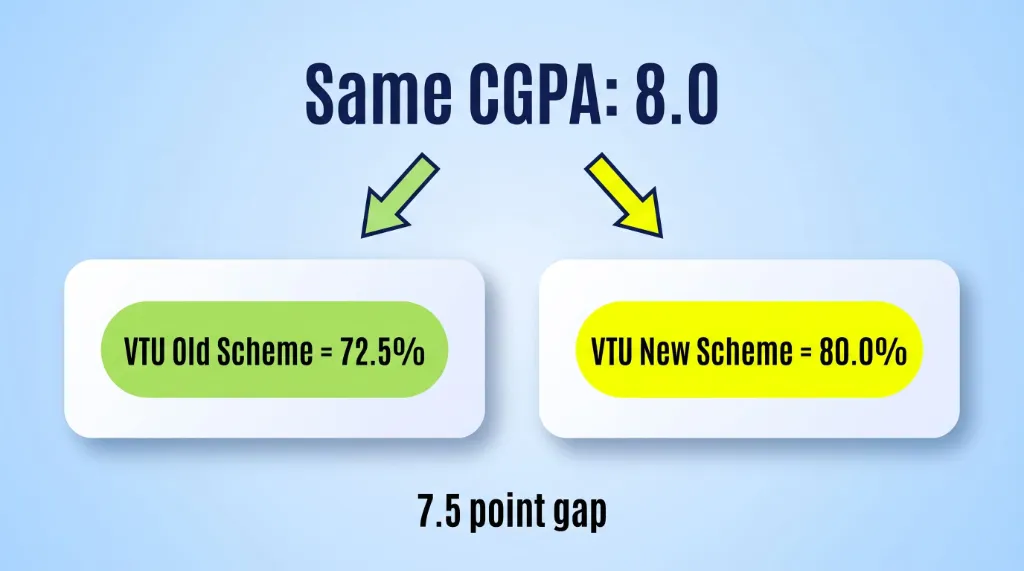
This is where standard online calculators mislead students. A student graduating from Visvesvaraya Technological University (VTU) under the 2018 scheme calculates percentage as (CGPA − 0.75) × 10. A student with an 8.0 CGPA receives 72.5%. However, under VTU’s updated 2021 CBCS scheme, the formula is CGPA × 10, giving the exact same 8.0 student an 80.0%.
That represents a dramatic 7.5 percentage point discrepancy for the exact same numerical GPA, solely determined by which academic notification governs their graduation year!
Here is how verified Indian universities regulate percentage conversion across state boards and central institutions:
| University / Institution | Applicable Regulation | Official Formula | Dedicated Tool |
|---|---|---|---|
| Central Board of Secondary Education (CBSE) | Class 10 / 12 Board Exams | CGPA × 9.5 | Home Calculator |
| Visvesvaraya Technological University (VTU) | 2021 & 2022 CBCS Scheme | CGPA × 10 | VTU Calculator |
| Visvesvaraya Technological University (VTU) | 2015, 2017 & 2018 Scheme | (CGPA − 0.75) × 10 | VTU Calculator |
| APJ Abdul Kalam Technological University (KTU) | B.Tech Ordinances (2015, 2019) | CGPA × 10 | KTU Calculator |
| Anna University, Chennai | CBCS Regulations 2017 & 2021 | CGPA × 10 | Anna Univ Tool |
| Vellore Institute of Technology (VIT) | Academic Regulations Circular 2008+ | CGPA × 10 | VIT Calculator |
| University of Mumbai (MU) | CBCS 7-Point & 10-Point Grading | (CGPA × 7.1) + 11 | Mumbai Univ Tool |
| Gujarat Technological University (GTU) | Degree & Diploma Regulations | (CGPA − 0.5) × 10 | GTU Calculator |
| Savitribai Phule Pune University (SPPU) | Engineering & Science Ordinances | (CGPA − 0.75) × 10 | SPPU Calculator |
| Maulana Abul Kalam Azad University (MAKAUT) | West Bengal CBCS Framework | (CGPA − 0.75) × 10 | MAKAUT Tool |
| Dr. A.P.J. Abdul Kalam Technical University (AKTU) | UP Technical Engineering Ordinances | (CGPA − 0.75) × 10 | AKTU Calculator |
| Biju Patnaik University of Technology (BPUT) | Odisha Engineering CBCS Scheme | (CGPA − 0.5) × 10 | BPUT Calculator |
| Amity University | Academic Regulations | CGPA × 9.5 | Amity Tool |
Statutory Verification Disclaimer
All university formulas listed above are sourced directly from verified Controller of Examination (CoE) circulars, Choice Based Credit System (CBCS) implementation notifications, and university transcript guidelines. Always cross-check the reverse side of your official university grade card for batch-specific nuances.
Frequently Asked Questions (FAQs)
Can you convert CGPA to percentage simply by multiplying by 10?
Only if your specific university regulations mandate it. While institutions like Anna University, KTU Kerala, and VIT use CGPA × 10, applying this multiplier at CBSE, UGC-affiliated colleges, or VTU (pre-2021) will overstate your percentage by 4% to 7.5%, which can disqualify applications during physical document verification.
Why does CBSE multiply CGPA by 9.5 instead of 10?
CBSE determined through historical board data analysis that the average score of students achieving the highest grade point (10) was 95 marks, not 100. Multiplying by 9.5 reflects the true statistical mean of high-performing cohorts across India.
Is the CGPA to percentage formula the same for all engineering colleges?
No. While CBSE, UGC, and AICTE follow the 9.5 multiplier, numerous state technical universities use their own formulas. For example, Anna University, KTU, and VIT use CGPA × 10, while VTU, SPPU, AKTU, and MAKAUT subtract an offset (0.75) before multiplying by 10.
What is 7.5 CGPA in percentage?
Under the standard CBSE / UGC formula, 7.5 CGPA equals 71.25% (7.5 × 9.5 = 71.25%). Under VTU CBCS or Anna University, 7.5 CGPA converts to 75.0% (7.5 × 10 = 75.00%).
Can SGPA be converted to percentage using the same formula?
Yes. Because SGPA represents your grade point average for a single semester calculated on the same 10-point credit system, the identical multiplier applies to compute semester-wise percentage. Check our SGPA to Percentage Calculator for semester calculations.
Can I use this calculated percentage on official job applications?
Yes, provided you match the formula specified in your university’s official conversion circular. When applying for government examinations (UPSC, SSC) or campus placements, attach your university’s official conversion notification alongside your grade card if requested.
Summary & Next Steps
Always verify whether your passing year falls under an older scheme or the modern CBCS framework before submitting official applications. Curious what letter grade your CGPA translates to? Use our Final Grade Calculator. Have an inquiry about an unlisted university? Contact our academic team and we will verify the circular and add it to the platform.